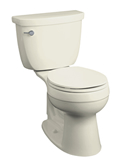
| Toilet evolution Though they still look pretty much the same, toilets have come a long way. Before the 1950s, toilets used approximately seven gallons for each flush. By the end of the 1960s, toilets flushed with only 5.5 gallons. The 1980s brought gallons-per-flush (gpf) rates down to 3.5. Today, spurred by water-conservation movements, toilets are flushing with only 1.6 gallons of water. In fact, in 1994, the National Energy Policy Act (H.R. 776) went into effect mandating a rate of 1.6 gpf for the entire United States. Manufacturers, in an attempt to produce toilets compliant with the new legal standards, tweaked the valves and floats in the tank to reduce water usage. Unfortunately, manufacturers didn't make changes to the tank or bowl, which left consumers with frequently clogged toilets and bowls that didn't clear out properly. Two or more flushes per use were often needed in order to get the bowl to empty completely. All of this increased flushing cancelled out the primary intention of low-flow toilets -- water conservation. Engineers began to change the trap diameter and shape in an attempt to improve the performance of 1.6-gpf toilets. They quickly found that enlarging the trap reduced siphonic pull, resulting in an inefficiently flushed toilet. To counter this reduced siphoning power, designers began manipulating the trap's curve, finding that minimally curved traps maximize the water's pull. Ads by GoogleSamochód Z USASamochodyAuto AuctionsOnline Auto Dealer Trends in toilets include models with a higher seat (as much as 17 inches off the floor), which makes it easier to get on and off. Elongated bowls are also more popular, with many models that are compliant with standards set by the Americans with Disabilities Act (ADA). Dual-flush toilets have been in Europe and Australia for years, but are now gaining in popularity in the U.S. Dual-flush toilets let you choose between a 1-gallon (or less) flush for liquid waste and a 1.6-gallon flush for solid waste. With recent home-improvement trends and high home-sale prices, there's a greater interest in better-looking toilets. As a result, toilets have received a face-lift. Not only have the color choices been expanded to include earth tones, but also designer toilets are now available in cherry, mahogany, leather, stainless steel, 1950’s powder blue, pink and even toilets designed to look like hatboxes. Types of toilets Toilets consume 30% to 40% of the total water used in homes, making them the biggest water users. Replacing an older 3.5-gallon toilet with a 1.6-gallon toilet could save an average of two gallons-per-flush, totaling a household savings of 12,000 gallons of water per year. Dual-flush 1.6- gpf toilets reduce water consumption by an additional 30%. You might want to check with your local utility company; many municipalities offer rebates that can defray the cost of a new, more efficient toilet. City municipalities, which have installed 1.6-gpf toilets, report reduced total water demand and reduced wastewater flow of 15% to 20%, saving taxpayers millions of dollars per year. Toilets come in several main types: Pressure-assist, power-assist, vacuum-assist and gravity. Be sure to compare like categories when you are shopping. Otherwise, you end up comparing apples to oranges. In general, reviews say to expect to pay between $250 and $350 for a good toilet. Gravity toilets: This is the most familiar type of toilet. Here, water drops from the tank into the bowl and trap, moving waste down the drain. Gravity does all the work, which makes them a good choice for homes that don't get great water pressure (as low as 10 pounds per square inch should be fine). Gravity toilets have a proven design and appeal to those who want a quiet flush. Since there's not much fancy technology inside the tank, repairs are easier. However, lower-priced models don't typically fare as well in testing. The best gravity toilets can cost as much as generally better pressure-assist toilets. Prices range from about $150 to $500. Pressure-assist toilets: These are the most powerful toilets, best suited for large families or heavy use. The toilet's water supply provides the pressure to compress air within a sealed plastic reservoir inside the tank. When the incoming water reaches the fill line, the tank is pressurized and ready for the next flush. During flushing, the air under pressure creates a loud "whoosh" as water blasts into the bowl; this noise can startle small children and people who like to flush while seated. Up to 80% of the flush water is used to purge the bowl, making for a very efficient flush. These toilets work great as long as the household water pressure is at least 25 pounds per square inch (psi). Pressure- assist toilets can solve problems in homes with older plumbing systems where gravity-fed 1.6-gpf toilets just aren't strong enough to pull waste through the older pipes. Prices generally range from $225 to $400. Pressure-assist toilets are generally better than gravity toilets, but their more complicated inner workings make them harder to repair. Vacuum-assist toilets: In these toilets, the tank houses a vacuum chamber that works like a siphon to pull air out of the trap below the bowl so that it can quickly fill with water to clear waste. These toilets, like power-assist models, work well in close quarters or bathrooms located near bedrooms, where you'd want a quiet toilet. Vacuum-assist toilets typically have less power than pressure-assist toilets, and are not as widely manufactured as other toilet types, so there are fewer choices. In general, these toilets range in price from $200 to $350. In reviews, experts recommend pressure- assist toilets over vacuum toilets. Power-assist toilets: Power-assist toilets plug into a standard GFCI outlet and use electricity to power a pump that pushes water into the toilet bowl. These quiet operators work well in close quarters or bathrooms located near bedrooms. A self-closing seat, which may be added to any toilet for about $50, eliminates the loud clanking associated with a toilet seat dropping on porcelain. This type of toilet is expensive; prices start at about $900. In home-improvement stores, you'll see familiar-looking two-piece toilets alongside newer one- piece toilets. The one-piece models incorporate the tank, bowl and seat into one piece of hardware. A one-piece toilet is easier to clean, doesn’t leak between the bowl and tank, and is typically more expensive than a two-piece toilet. The tank and bowl are separate in two-piece toilets, and the toilet seat is usually not included with the bowl. Two-piece toilets are usually less expensive than one-piece toilets, but they're a little harder to clean. The vast majority of toilets still mount on the floor over a trap that leads to the sewer main. But you can also find wall-mounted toilets, which require a special plumbing setup. Wall-mounted toilets are more expensive, generally over $500. A wall-mounted toilet allows for easier floor cleaning. Toilet bowls are available in two basic shapes -- round and elongated. Round bowls save space; elongated bowls are more oval in shape, and are a bit more comfortable as well. Elongated bowls are usually 2" longer than round bowls. With their larger water surface, elongated bowls are recommended by the ADA for seniors or those with disabilities. |

Copyright 2008 Mark's Construction and Remodeling of IL, Inc. All rights reserved.
| Call us for a free estimate: 847-394-9846 773-485-8000 773-727-8058 |
 |
| Design by Krystyna Puka 773-983-8021 |